
-
PERSONAL STATEMENT ON INABILITY TO DRIVE, WORK, OR HOLD ADRIVER’S LICENSE
GALLERY & ATTACHMENTS
CONTENT
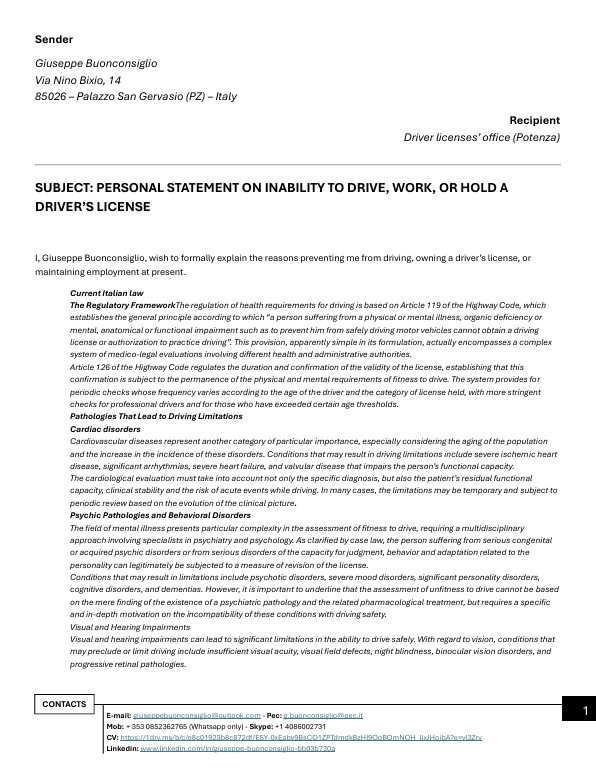
I, Giuseppe Buonconsiglio, wish to formally explain the reasons preventing me from driving, owning a driver’s license, or maintaining employment at present.
Current Italian law
The Regulatory FrameworkThe regulation of health requirements for driving is based on Article 119 of the Highway Code, which establishes the general principle according to which “a person suffering from a physical or mental illness, organic deficiency or mental, anatomical or functional impairment such as to prevent him from safely driving motor vehicles cannot obtain a driving license or authorization to practice driving”. This provision, apparently simple in its formulation, actually encompasses a complex system of medico-legal evaluations involving different health and administrative authorities.
Article 126 of the Highway Code regulates the duration and confirmation of the validity of the license, establishing that this confirmation is subject to the permanence of the physical and mental requirements of fitness to drive. The system provides for periodic checks whose frequency varies according to the age of the driver and the category of license held, with more stringent checks for professional drivers and for those who have exceeded certain age thresholds.
Pathologies That Lead to Driving Limitations
Cardiac disorders
Cardiovascular diseases represent another category of particular importance, especially considering the aging of the population and the increase in the incidence of these disorders. Conditions that may result in driving limitations include severe ischemic heart disease, significant arrhythmias, severe heart failure, and valvular disease that impairs the person’s functional capacity. The cardiological evaluation must take into account not only the specific diagnosis, but also the patient’s residual functional capacity, clinical stability and the risk of acute events while driving. In many cases, the limitations may be temporary and subject to periodic review based on the evolution of the clinical picture.
Psychic Pathologies and Behavioral Disorders
The field of mental illness presents particular complexity in the assessment of fitness to drive, requiring a multidisciplinary approach involving specialists in psychiatry and psychology. As clarified by case law, the person suffering from serious congenital or acquired psychic disorders or from serious disorders of the capacity for judgment, behavior and adaptation related to the personality can legitimately be subjected to a measure of revision of the license.
Conditions that may result in limitations include psychotic disorders, severe mood disorders, significant personality disorders, cognitive disorders, and dementias. However, it is important to underline that the assessment of unfitness to drive cannot be based on the mere finding of the existence of a psychiatric pathology and the related pharmacological treatment, but requires a specific and in-depth motivation on the incompatibility of these conditions with driving safety.
Visual and Hearing Impairments
Visual and hearing impairments can lead to significant limitations in the ability to drive safely. With regard to vision, conditions that may preclude or limit driving include insufficient visual acuity, visual field defects, night blindness, binocular vision disorders, and progressive retinal pathologies.
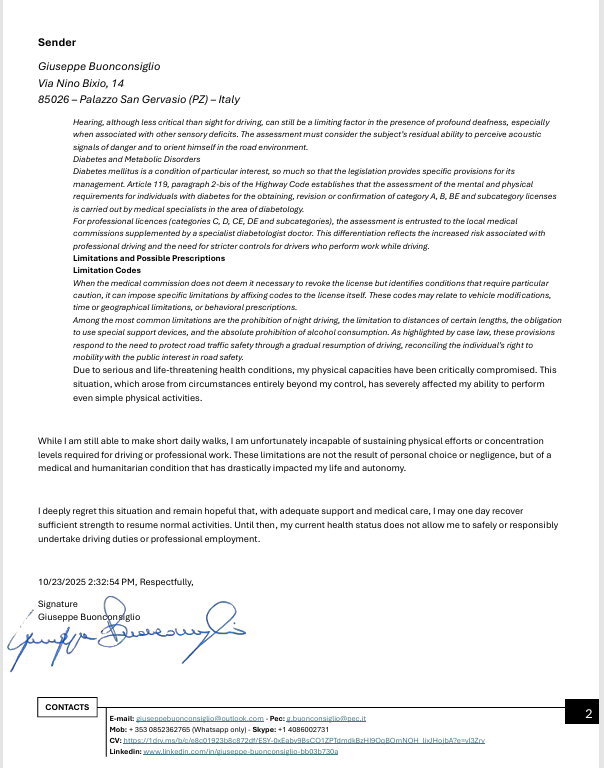
Hearing, although less critical than sight for driving, can still be a limiting factor in the presence of profound deafness, especially when associated with other sensory deficits. The assessment must consider the subject’s residual ability to perceive acoustic signals of danger and to orient himself in the road environment.
Diabetes and Metabolic Disorders
Diabetes mellitus is a condition of particular interest, so much so that the legislation provides specific provisions for its management. Article 119, paragraph 2-bis of the Highway Code establishes that the assessment of the mental and physical requirements for individuals with diabetes for the obtaining, revision or confirmation of category A, B, BE and subcategory licenses is carried out by medical specialists in the area of diabetology. For professional licences (categories C, D, CE, DE and subcategories), the assessment is entrusted to the local medical commissions supplemented by a specialist diabetologist doctor. This differentiation reflects the increased risk associated with professional driving and the need for stricter controls for drivers who perform work while driving.
Limitations and Possible Prescriptions
Limitation Codes
When the medical commission does not deem it necessary to revoke the license but identifies conditions that require particular caution, it can impose specific limitations by affixing codes to the license itself. These codes may relate to vehicle modifications, time or geographical limitations, or behavioral prescriptions. Among the most common limitations are the prohibition of night driving, the limitation to distances of certain lengths, the obligation to use special support devices, and the absolute prohibition of alcohol consumption. As highlighted by case law, these provisions respond to the need to protect road traffic safety through a gradual resumption of driving, reconciling the individual’s right to mobility with the public interest in road safety. Due to serious and life-threatening health conditions, my physical capacities have been critically compromised. This situation, which arose from circumstances entirely beyond my control, has severely affected my ability to perform even simple physical activities.
While I am still able to make short daily walks, I am unfortunately incapable of sustaining physical efforts or concentration levels required for driving or professional work. These limitations are not the result of personal choice or negligence, but of a medical and humanitarian condition that has drastically impacted my life and autonomy.
I deeply regret this situation and remain hopeful that, with adequate support and medical care, I may one day recover sufficient strength to resume normal activities. Until then, my current health status does not allow me to safely or responsibly undertake driving duties or professional employment.
GS4IHR
Join me in fighting for human rights today.
Contacts
© 2025. All rights reserved.
Phone